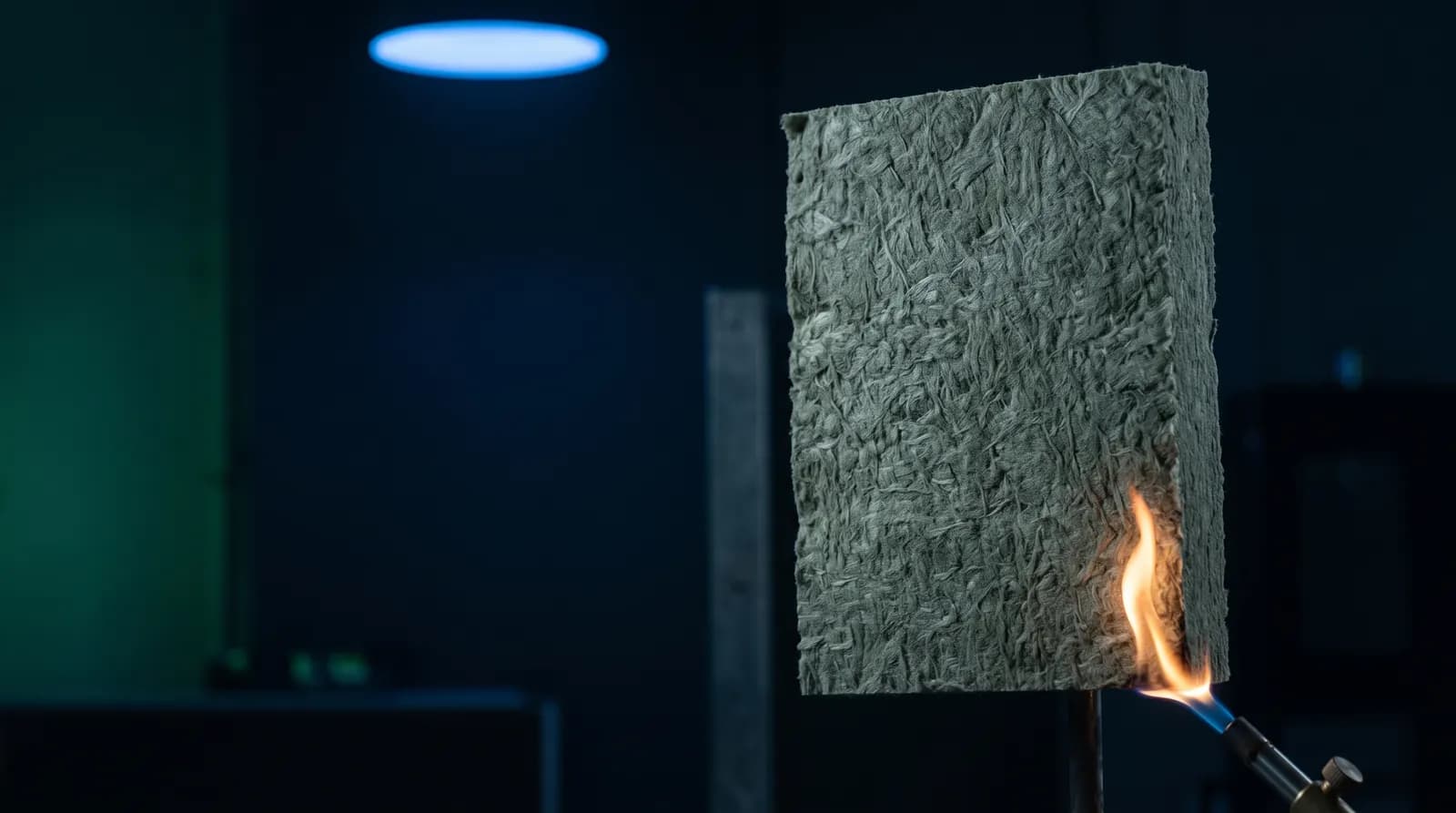
Fire Safety in EWI Systems: Materials, Testing, and Compliance
How external wall insulation is fire-rated in the UK: Euroclass classifications, BS 8414 facade testing, building height thresholds, and why A1-rated mineral wool systems lead modern specifications.
Fire safety is now the first question any responsible specifier asks about external wall insulation, and rightly so. Since 2017 the UK has rebuilt its rules on cladding and insulation from the ground up, and the difference between a compliant EWI system and a non-compliant one comes down to tested materials, recognised classifications, and correct installation. This guide explains the ratings, the tests, and the regulations in plain English, and shows how modern mineral wool systems achieve the highest fire classification available.
Why fire safety leads every EWI conversation
The regulatory landscape for external walls changed permanently after the Grenfell Tower fire. The Building Safety Act 2022 created the Building Safety Regulator, which sits within the Health and Safety Executive and oversees higher-risk buildings in England — broadly those of 18 metres or at least seven storeys. Approved Document B (the fire safety volume of Building Regulations guidance for England) was tightened, and industry bodies such as INCA published updated technical guidance on fire performance requirements for EWI systems.
The practical effect is straightforward: an EWI system today should come with documented fire classifications for the whole build-up, not vague assurances about individual ingredients — and installers should follow the certified specification to the letter.
Euroclass ratings: what A1, A2 and B actually mean
Reaction-to-fire performance in the UK is classified under BS EN 13501-1, the European standard that produces the familiar Euroclass ratings. The scale runs from A1 down to F:
- A1 — non-combustible. The material makes no contribution to fire at any stage, including a fully developed fire. This is the highest classification available.
- A2 — limited combustibility. Materials in this class make no significant contribution to fire growth.
- B — combustible but with a very limited contribution to fire.
- C to E — progressively greater contribution to fire.
- F — no performance determined.
Classifications from A2 downwards also carry supplementary indices: an "s" score for smoke production (s1 lowest, s3 highest) and a "d" score for flaming droplets (d0 meaning none). So a rating of A2-s1, d0 means limited combustibility, minimal smoke, and no burning droplets.
Two points matter when reading these ratings. First, the classification comes from laboratory testing — including single burning item testing to EN 13823 — carried out by accredited laboratories, not from manufacturer opinion. Second, and crucially for EWI, the rating that counts is the one awarded to the complete tested build-up: substrate, adhesive, insulation, basecoat, mesh and finish together. A system is not "A1" just because one component in it is.
How the main EWI insulation materials compare
The insulation board at the heart of an EWI system does most of the work in determining its fire class:
- Mineral wool is inherently non-combustible and can achieve Euroclass A1 as part of a full system. It is the default choice where fire performance is the priority, and it also brings vapour permeability, which suits older solid-wall properties.
- Expanded polystyrene (EPS) is a combustible plastic insulant. Within a properly designed system — fully encapsulated in a cementitious basecoat, mesh and render — EPS-based build-ups can achieve a Euroclass B system rating, and regulations still permit them on many lower-rise buildings. EPS is never used bare; the render encapsulation is integral to its tested performance.
- Rigid foams such as PIR and phenolic offer the lowest thermal conductivity, allowing thinner build-ups, but they are combustible and their use on taller residential buildings is restricted.
- Foamed glass is a less common A1-classified option, valued for its water resistance.
The render finish matters too. In EWI Pro's tested range — the system APEX installs — mineral wool with a mineral render and silicone paint finish is classified A1, mineral wool with a silicone render achieves A2, and EPS with a silicone render achieves Euroclass B. The finish coat is part of the tested system, which is one more reason substituting components on site is never acceptable.
Large-scale testing: BS 8414 and BR 135
Small-sample Euroclass testing tells you how materials react to fire; it does not by itself tell you how a full facade behaves. That is the job of BS 8414, the UK's large-scale facade fire test. A complete wall system around nine metres tall is built onto a rig — a masonry substrate (BS 8414-1) or a structural frame (BS 8414-2) — and exposed to a severe fire source representing flames breaking out of a window. Sensors track whether fire spreads up and within the system, and results are assessed against the criteria in BRE report BR 135.
For most buildings, a system route to compliance uses either components meeting the required Euroclass ratings or a full system assessment. [VERIFY: current status of BS 8414/BR 135 as a compliance route in Approved Document B — the guidance on when large-scale test evidence may be used instead of the non-combustibility route has been amended more than once and should be checked against the latest edition.]
Building height thresholds and the combustibles ban
Height is the single biggest factor deciding which insulation materials the regulations allow on a given wall:
- Over 18 metres in England: external walls of residential buildings above this height are subject to the ban on combustible materials, meaning insulation and cladding must generally achieve Euroclass A2-s1, d0 or better. [VERIFY: exact scope and clause — the ban sits in regulation 7(2) of the Building Regulations 2010 as amended, and its list of exempted components and covered building uses has been revised since 2018.]
- 11 to 18 metres in England: guidance for new residential buildings in this band has been tightened, with strong pressure towards non-combustible solutions. [VERIFY: current Approved Document B provisions for the 11–18 m band.]
- Scotland: the threshold for requiring non-combustible external wall construction is 11 metres. [VERIFY: current Scottish technical handbook requirements.]
- Higher-risk buildings (18 metres or seven storeys and above in England) additionally fall under the Building Safety Regulator's gateway approval regime, adding scrutiny at design and completion stages.
For the typical two-storey house — the bulk of APEX's work — none of these height restrictions bite, and both mineral wool and encapsulated EPS systems are permitted. Even so, many homeowners now choose mineral wool for the reassurance of an A1-rated wall.
Fire resistance and certified system build-ups
Reaction to fire is only half the picture. Fire resistance — classified under BS EN 13501-2 — measures how long a construction maintains integrity (E) and insulation (I) during a fire, expressed in minutes. EWI Pro has had typical system configurations tested for non-structural fire resistance, with results reported of EI 45 for EPS systems and EI 120 for mineral wool systems on masonry and steel-frame walls. [VERIFY: these EI figures and their exact tested configurations against the current EWI Pro classification reports.]
Third-party certification pulls all of this evidence together. EWI Pro's steel-frame EWI system, for example, holds a BDA Agrement certificate issued by Kiwa [VERIFY: certificate reference BAW-25-375-S-A-UK], covering a dual-density mineral wool build-up with a system classification of A2-s1, d0 — a rating that supports use without height restriction, subject to the national regulations. For masonry homes, the equivalent assurance comes from the tested and classified system documents for the mineral wool and EPS ranges.
The consistent theme across every certificate is that the approval covers a defined build-up: named adhesive, specified insulation, set fixing patterns, approved mesh, primer and finish. Compliance lives or dies on installing exactly what was tested.
Fire performance without sacrificing insulation
A common worry is that choosing the safest material means accepting a colder wall. In practice the trade-off is thickness, not performance. Mineral wool has a slightly higher thermal conductivity than rigid foams — around 0.036 W/m·K for dual-density EWI slabs — so it needs a modestly thicker board to hit the same U-value. Approved Document L guidance points renovated walls towards a U-value of roughly 0.30 W/m²K, and a mineral wool EWI system reaches that comfortably on a typical solid brick wall with a build-up around 100 mm. An A1-rated wall and a warm home are not in tension; they are the same specification.
What this means for your project
For most UK homes the compliance picture is reassuring: tested, certified EWI systems exist for every common wall type, and the choice between A1 mineral wool and encapsulated EPS can be made on the merits of the property rather than under regulatory pressure. What matters is that the system is specified as a whole, installed exactly to its certification, and documented so you can evidence what is on your walls. APEX installs EWI Pro's certified systems — including the A1-rated mineral wool build-up — and follows the tested specification on every job. If you would like to know which system suits your property, book a free survey and quote with APEX and we will walk you through the options.
// RELATED
More Articles

Free External Wall Insulation Grants in the UK: A 2026 Eligibility Guide
How free external wall insulation funding works in the UK: the main 2026 grant schemes, benefit and EPC-based eligibility rules, and how to check your own home's options.
EWI and Building Regulations: What You Need to Know
A plain-English guide to how UK building regulations apply to external wall insulation — Part L U-values, notification routes, fire and moisture rules, and the PAS 2035 retrofit framework.
// EXPERT GUIDANCE
Need Professional Advice?
Our technical team is here to help with your EWI or rendering project. Get professional guidance tailored to your specific requirements.